Showing posts with label business. Show all posts

Friday, May 3, 2024

The Cole County Bank: Victim of the Great Depression

The Southside began to take off with its own business district in the decades around 1900. By then the original German immigrants were dying off and the younger generation spoke English. Folks no longer used the German “Muenchberg” but began using calling it Jefferson City’s “Southside.”

On summer evening in 1912, as they sat under shade trees in Friemel’s beer garden—on a grassy hillside across from today’s Central Dairy ice cream parlor—an informal, tight-knit group of businessmen who called themselves the “Southside Boosters” discussed the need for a community bank in the growing Southside. They chose the name “Cole County Bank” because much of the Southside’s business came from farmers in the county.

The boosters had no trouble soliciting stock, and on October 17, 1912, the Cole County Bank was incorporated with a capitalization of $25,000. The bank had eighty-five shareholders, all of whom were listed in the local newspaper with the number of shares each owned at $100 per share.

Among the shareholders were:

  • Jacob F. Moerschel (of the Capitol Brewery),
  • George Bartholomaeus (co-owner of the Dunklin Theater),
  • John W. Fischer (a prominent farmer),
  • Joseph Pope (a street contractor),
  • Wm. F. Winkelmann (a farmer and banker),
  • T. G. Nilges (a grocer and city councilman),
  • Ernst Simonsen (a manufacturer and the namesake of the high school), and
  • members of the Dulle, Bassmann, Busch, Schmidt, Tanner, Seidel, Renn, Sommerer, Schell, and Kielman families.

The list even included Hugh Stephens (printer and banker). Officers at incorporation were T. G. Nilges, president; J. W. Fischer and A. W. Happy, vice-presidents; and Wm. F. Winkelmann, cashier and secretary.

The bank officers narrowed the location for their new bank down to two sites. One was “Schmidt’s Corner,” the southwest corner of Dunklin and Madison, where the Henry Schmidt Grocery was (now known as the Wel-Com-Inn). The other site was “Kielman's Corner,” the southeast corner of Dunklin and Jefferson, where the Farmer’s Home hotel was and still is, with ECCO Lounge in part of it.

They chose Kielman’s Farmer’s Home and began operations in 1912 in the corner room of the hotel. A separate Southside Building and Loan Association, organized to provide loans for the large number of new houses then going up in the Southside, operated in conjunction with the bank.

At the same time that the Cole County Bank got going, Henry Schwartze quit his blacksmith and wagon repair business in the building catty-cornered from Farmer’s Home, the northwest corner of the same intersection. In 1914 that vacant two-story brick building was completely renovated into a retail business downstairs and offices upstairs. The old doorways, wide enough for wagons, were bricked in, new windows installed, and the interior space divided into rooms. The address today is 626 Jefferson Street.

The original, soft-brick exterior walls of the 1880s were replaced, or covered over, with new wire-brushed, resistant brick to give the building the completely different appearance that you can see today.

Following this thorough building renovation in 1914, the Southside Drug Store and Jefferson City’s first branch post office opened on the first floor, and doctors’ offices on the second floor.

The corner room in the Farmer’s Home building had become entirely too small for the growing Cole County Bank, so shortly after 1921, the bank left that corner room and moved diagonally across the corner into the larger space that the Southside Drug Store had occupied. The drug store simply moved next door on the north, where it stayed into the 1960s. Doctors and dentists remained on the second floor.

The bank advertised heavily in both German and English newspapers. A neighborhood bank was a great help to Southsiders. They could do their banking while shopping in the Southside. Frugal families could create savings accounts rather than hiding their precious earnings in mattresses. They knew the officers and tellers and trusted them with their money.

Things went well during the 1920s. The bank quickly doubled its capitalization, then again recapitalized. In 1922 it passed the million-dollar mark in assets. As the population grew in the Southside and nearby farmers prospered, so did the bank.

Then the unexpected happened! The national stock market crashed in 1929, which brought on the Great Depression. Small banks were vulnerable to the economic hard times and the huge decline in circulating money. Nevertheless, people continued to trust their neighborhood bank with their money, just as they would a friend.

But the Cole County Bank was overextended. It had too many unsecured loans for its assets. For instance, the bank had to foreclose on the mortgaged Farmer’s Home hotel for only $500, when the building was worth several thousands of dollars. The bank just couldn’t sell the property. There were no buyers with money during the Great Depression.

Try as they could to keep afloat, the Cole County Bank finally was forced to close its doors in May 1938, paying only 62 1/2 cents on the dollar to shareholders. On November 9, 1938, the Director of Finance of the state of Missouri, after a six-month search to find owners of unclaimed deposits, liquidated all remaining assets. The bank had failed. The Southside Building and Loan Association, however, survived and stayed in business in that corner building.

Many Southsiders lost all their savings. Folks shared their sorrows with some bitterness. Single women, widows, aged couples, and younger people who were saving for retirement in those days before Social Security lost everything! Jack Howser, who as a young boy lived across the street in the Farmer’s Home hotel, had put his meager savings in the bank, and seventy-four years later, his painful loss of exactly $3.25 remained etched in his memory.

A bank organized by and for Southsiders and county farmers no longer exists. However, the Southside does have a branch facility of Jefferson City’s Hawthorn Bank, which is said to be their most used facility. In late 2013, its longtime motor bank was replaced by a completely new building on the corner of Dunklin and Washington, built to architecturally harmonize with the historic brick buildings of the neighborhood.

More recently, River Region Credit Union opened a drive-through facility and community room on Broadway at the Highway 50/63 expressway.

If you live, work, or visit in the Southside, you still have banking services in walking distance!

--------------------------------

This essay appeared, in slightly different form, in Walter A. Schroeder, Southside Sketches: Essays on Jefferson City’s Old Munichburg (Jefferson City: Old Munichburg Association, 2016). Copyright © 2026 by Walter A. Schroeder.

Tuesday, February 27, 2024

Jefferson City’s Early German Clubs: Turners and Germania

By Walter A. Schroeder, for Historic City of Jefferson

There’s a saying that when three Germans get together, they will organize and form a club with bylaws. That was certainly true among immigrant Germans in Jefferson City in the 19th century, but the clubs faded away after 1900 and are little known today because their German-language records inhibit research. In their heyday, German social clubs promoted the businesses and trades of their members and provided socialization in their traditional German way of singing, drinking, and dancing. These selective clubs were for men only, and they lacked membership from laborers and common folk.

The first of the clubs was the Turners, or Turnverein, organized in 1868. It was founded by Ernst Anton Zuendt, a freethinker and the first German teacher at the new public school. The principle of the Turner movement was the Greek ideal of “a sound mind in a sound body.” “Turner” means “gymnast,” and gymnastics were its principal exercise.

The local Turners in 1869 established a Turnergarten on a hill in the 600 block of Madison Street, opposite what is now Central Dairy, in an emerging Munichburg. As described by Julius Conrath Jr., the sprawling Turner Garden had a brick meeting house and “a long, wooden building . . . where wine, beer, and sandwiches were sold. Great crowds would gather there, particularly on Sunday afternoons. . . . We had a turnmaster who put us through the various exercises, and on the grounds were bars, racks, horses, swings, rings, and other appliances on which we performed.” Among events at the Turner Garden was an 1872 “masked military ball” for the Franz Sigel battery, a unit of Missouri German immigrants that had fought for the Union in the just-ended Civil War. Several of the Sigel unit’s veterans were residents of Jefferson City.

Zuendt resigned his public school teaching position in 1876 and left Jefferson City. The Turner Club disbanded in the mid-1870s. Ernst Friemel acquired the Turner Garden site in 1881 and turned it into the popular Friemel’s Garden. [For more on Friemel’s Garden, a hilltop gathering place for cold beer, sandwiches, picnics, music concerts, and dancing, see Walter A. Schroeder, Breweries and Saloons in Jefferson City, Missouri, (Jefferson City: Old Munichburg Association, 2009), 28–30.]

As the Turners faded, immigrants formed the Harmonie Club, or Harmonie Gesellschaft, primarily for singing. It was formally organized May 26, 1873, with 73 members. In 1873, it opened its own building, Harmonie Hall, in the 300 block of Madison Street. Harmonie dissolved about 1880 but reformed as the Germania Club.

On Feb. 8, 1883, German-speaking residents organized the Germania Club. “Germania” is the personification of the German nation—counterpart to Britannia for the United Kingdom and Columbia for the United States—and was associated with the drive in Germany to unify the German people. Germania clubs were established in many American cities.

In 1884, founding member Fred Binder [pronounced BINN-der], prominent local builder, built the Music Hall building, 236 E. High St., next to Bragg Hall (city hall), specifically for the Germania Club. At that time, the club had 55 members in business and the trades. The second-floor “Music Hall” was one single room, 90 by 30 feet, with 140 chairs, a stage, and dressing rooms.

Photo: The Music Hall, built in 1884 by Fred Binder for the Germania Club, was at 236 E. High St. next to Bragg Hall, the city hall. The distinctive, large plate glass windows were to allow the maximum of natural light into the hall before electricity. The Music Hall has been replaced by the current building that houses Samuel’s Menswear. (Source: 1900 Illustrated Sketch Book of Cole County, p. 231.)

The Germania Club held its grand opening on its first anniversary, Feb. 8, 1884, and met weekly thereafter. The club hosted visiting lecturers, presented dramas in German and English, and provided frequent musical entertainment by visitors and local groups. It was a cultural center for the growing city. The Music Hall building is no longer standing. The site is now occupied by Samuel’s Menswear.

The Germania Club served as a chamber of commerce to promote members’ businesses and provide a networking forum. Among its nearly 100 members were Binder, Dallmeyer, Priesmeyer, Brandenburger, Porth, Stampfli, Wagner, Knaup, Obermeyer, Bruns, Heinrichs, Fischer, Meyer, Monnig, and others who had High Street businesses. Wives attended its elegant social events. The club held weekly dances and masked balls and hosted parties for visitors from Germany. A local orchestra or cornet band provided music for the club’s activities. Germania gave annual Christmas parties for children, one of which in 1893 was attended by 250 children who sang, danced, and received gifts.

The Germania Club was the high point of German socialization in Jefferson City. It was the largest, most prestigious, and most active social club for German businessmen and civic leaders. It reached its peak in the 1890s, which marked the decade of greatest prominence of German-American identification and influence in Jefferson City.

By 1900, these businessmen and civic leaders were fluent English speakers and were fast losing their identity as a separate ethnic group. They also were members of other civic groups that provided larger forums for intercourse like the Commercial Club/Chamber of Commerce. They were serving in elected city offices and on the public school board. Assimilation was nearing completion. Thus, there was no longer a need for separate German social groups.

Walter Schroeder grew up in Jefferson City’s historic German Southside now known as Old Munichburg. A retired professor of geography, he is devoted to preserving cultural history and is the author of five books on the history of the Old Munichburg neighborhood.

Copyright © Walter A. Schroeder, 2021

[This article first appeared in the Jefferson City News-Tribune’s “Cole County History” series on Saturday, March 6, 2021. Slight editorial changes have been made in square brackets and to update for 2024 the name of Samuel’s Tuxedos and Gifts and the number of JC history books authored by Walter Schroeder. —ed.]

For more on the history of German Turner gymnastic societies, including the club swinging those societies are associated with, enjoy this YouTube video by Oliver Janseps.

Tuesday, November 6, 2018

Hott and Asel Baloney

In 1849, John Michael Asel and Margaret Barbara Mueller emigrated from Bavaria to the United States. After marriage in New York, they moved to the Muenchberg (Munichburg) area of Jefferson City, where other Germans were settling. They built a log cabin at the corner of Madison and Ashley streets that stood until the late 1960s. During the early years, the Asels befriended Indians camping on the south side of town with Barbara’s home-baked bread and John’s cured meats. They became charter members of Central Evangelical Church (now Central United Church of Christ) when the congregation organized in 1857.

In 1852, when Jefferson City had a population of about one thousand, John Asel established a meat market on High Street. According to a 1964 article in the Jefferson City News and Tribune, his first ovens and smokehouse were fueled by giant logs pulled as driftwood from the Missouri River. The slaughterhouse was along the river just downstream from where the bridge is now. In winter, ice cut from the Missouri River was stacked in a huge icehouse. During the Civil War, the Asel meat market sold sausage sandwiches to soldiers stationed in the city.

As Jefferson City grew after the war, the Asel meat market prospered not only among the large number of German immigrants but also among the city population in general. It gained a strong reputation for fresh and cured meats, especially for its smoked, cooked sausage made from recipes brought from Bavaria.

John Asel died in 1873 and Barbara in 1891, but several of their eight children continued in the meat business. In addition to the main High Street market, which had different locations on High Street, other Asel meat markets were at the corner of West Main and Bolivar and in Washington, Missouri. Among the advertised items in 1915 were pork ham roast, boiling beef, Porterhouse steak, sugar cured bellies, dry salt meat, smoked spareribs, fancy country hams, calf liver, sweetbreads, and homemade bockwurst every Saturday.

In 1915, John and Barbara’s son Christ (Christopher) Asel went into partnership with William Hott to establish the Crescent Meat Market in the commercial heart of Munichburg at 110 E. Dunklin (now a parking lot just east of the ECCO Lounge). A smokehouse was behind the store. A 1915 newspaper article described it as “clean as a pin and finished in oak, marble and plate glass,” with an enameled refrigerator. They carried a full line of meats, lard, and sausage, and the two proprietors were noted for their courtesy. Christ’s son Ralph was a butcher apprentice in the market.

On June 1, 1931, William Hott and Ralph Asel relocated the meat market to a new building at 711 Madison Street, on land that had been in the Asel family since John and Barbara built their log cabin around 1850. William Hott retired in 1940, but Ralph Asel continued to operate the meat market alone under the name of “Hott & Asel” for another twenty-four years. It is this location, on Madison Street, that is so well remembered by Southsiders as the place to go to get their meat, especially the famous Hott & Asel garlic baloney.

Until 1964, a small creek ran behind the Madison Street store and went underground at the intersection of Madison and Dunklin. The wooded land around the creek was “the jungle” to Ralph’s nephews, Bill and Tom Asel, who lived nearby, at the corner of Ashley and Madison. Ralph Asel had no children, and Bill and Tom recall their Uncle Ralph awakening them early in the morning, before school, to chop cloves of fresh garlic and to chop wood for smoking the famous baloney. The boys also tied the sausage links while holding their hands in “salty, briney water that really toughened up our hands.” The smokehouse was just behind the market, along the creek, and the entire Munichburg neighborhood could tell, from the powerful aroma, when Ralph Asel was making fresh baloney. To the locals, “good eatin’” was Hott & Asel baloney, soda crackers, and a bottle of Moerschel’s beer from the Capital City Brewery.


The store was plain and immaculately clean. A single display case surmounted with a large scale was the central fixture. Behind it was a butcher table for cutting and packaging meats and a table where Mrs. Asel would knit and answer the telephone. A lattice-topped partition framed the opening to a large, walk-in refrigerator behind which was a workroom for butchering. Neighborhood boys remember the store by the antlers on the walls and the sawdust on the floor. Women, who did most of the grocery shopping then, remember the friendliness and candid humor of Ralph and his wife, Milburn.

When he retired in 1964, Ralph told the News and Tribune that he and Mrs. Asel were finally going to take their honeymoon trip: “We probably will go to Florida, Cuba, Paris—and other Missouri towns.”

Ralph Asel closed his business on June 30, 1964, ending 102 years of Asel meat markets in Jefferson City. He sold the building to Milo Walz, who cleared and filled the land behind the building, put the creek underground, and build a hardware store with a concrete parking lot. (See the historic photos on this post.)

----------------------

Old timers recall snacking on Hott & Asel baloney, soda crackers, and beer after a baseball game or in the middle of the day. Though Jefferson City residents could no longer buy their favorite baloney after 1964, the recipes were not lost. One of the recipes was passed on from Ralph Asel to Johnny Wilbers, a butcher who worked at a grocery store on Monroe Street. Johnny Wilbers then passed the recipe on to his son, Dick Wilbers. In 2004, Dick operated Johnny’s Butcher Shop & Bar-B-Que off Route B, where Viet’s Pub and Grill is in 2018. With Dick Wilbers’s cooperation, and the meat processing services of Swiss Meat and Sausage Company near Hermann, Missouri, the Old Munichburg Association was able to bring back Ralph Asel’s Hott & Asel baloney in 2004. We sold 400 pounds of it in one-pound rings at Oktoberfest, so festival attendees could recreate the pleasures of the past. Dick Wilbers passed away in January 2011.

Early in 2005, another garlic baloney recipe was discovered in a book published by William Hott in 1912. His Secrets of Meat Curing and Sausage Making included another variation of the baloney fondly referred to as Hott & Asel Baloney. So in 2005, the Old Munichburg Association again hired the Swiss Meat & Sausage Company to produce a limited quantity of garlic baloney, this time using the Hott recipe. The association sold 1-lb. rings of the baloney at Oktoberfest for $7 each or 3 for $20. We also made 1/4-lb. sausage packages, which we sold as part of an "Oktoberfest Snack-Pack" in good old-fashioned white paper sacks, along with crackers and samples of Munichburg member Jo Meyer's Mama Jo's Gourmet Honey Mustard. It was fun to offer this unique baloney relished by generations of Jefferson City residents.


Updating this story in 2018, we’d like to note that our friends at Swiss Meat and Sausage Company, which produced the association’s recipes for Hott & Asel baloney, sell 8 ounce chubs of their Rhine Valley German Style Bologna that is a LOT like the Hott & Asel recipe. It’s fully cooked, though it must be refrigerated or kept frozen. If you haven’t been to their shop, about eleven miles south of Hermann on MO 19, you should go there sometime. Lots of deals on some tasty meats! If you can’t make it there personally, remember that they can ship anywhere in the continental United States! (Christmas is coming . . . !)

And if you’ve enjoyed this little trip down memory lane, consider sending a contribution to the Old Munichburg Association, for helping keep these memories alive.


Monday, April 30, 2018

Hugo Busch and Busch's Florist

In 1890 German immigrant Hugo Otto Busch and partner Charles Purzner bought Mathias Nagel’s florist and landscape business on the corner of Madison and East Dunklin. Nagel had been in business there since at least 1873. Busch bought out his partner in 1902 and expanded the business, calling it Capital City Greenhouse. In 1909 he purchased 25 acres of farmland between the 1400 blocks of St. Mary’s Blvd. and Missouri Blvd. to raise plants and flowers. That land today is occupied by Jefferson Plaza and Busch St. In the 1930s Busch had eight large greenhouses: six were on Missouri Blvd., and two were connected to the sales room on Madison Street. He had a total of 50,000 square feet under glass. Busch annually raised thousands of poinsettias, roses, and carnations for his business and for wholesaling. Busch’s Florist served the general public with cut flowers and bedding plants and also decorated for weddings, funerals, and church events and for state government functions at the Capitol and governors’ inaugurations. Busch’s began FTD service around 1920 and rose to rank among FTD’s national leaders. Busch’s has long been considered Jefferson City’s premier florist.

Hugo and his German immigrant wife Lina (Carolina Jung) lived at 117 East Dunklin (part of the business property), where they raised eight sons and two daughters. Six of the sons worked with their father at some time. Son Arthur began working in the 1930s and in 1955 assumed control of the business when his father died at age 89. Art and wife Leota were known for their personal attention to customers and for their friendly, skilled employees. Art died in 1990, and Leota continued until 1997, when the business left the Busch family after 107 years. John Pelzer then owned it, proudly continuing the name Busch’s Florist. The business is now owned by Reid Millard, who in 2018 has renovated the landmark greenhouse on “the most beautiful corner in Jefferson City.”

Hugo Busch was a founding member of Southside Boosters that formed in 1912 to promote the Southside. Busch’s Florist has been an anchor to its business community for more than a century and is an active member of the Old Munichburg Association.

This piece originally ran in the Jefferson City News Tribune.

Copyright 2018, by Walter A. Schroeder

Photo of Hugo Busch, age 79 (1945), courtesy Trinity Lutheran Church, Jefferson City, Missouri

Friday, March 15, 2013

The Cole County Bank

The Southside began to take off with its own business district in the decades around 1900. By then, the original German immigrants were dying off and the younger generation spoke English. Folks no longer used the German “Muenchberg” but began called the area “Jefferson City’s Southside.”

Sitting under shade trees in Friemel’s beer garden one summer evening in 1912, an informal, tight-knit group of businessmen who called themselves the “Southside Boosters” saw the need for a community bank in the growing Southside. They chose the name “Cole County Bank” because much of the Southside’s business came from farmers in the county. The boosters had no trouble soliciting stock, and on October 17, 1912, the Cole County Bank was incorporated with a capitalization of $25,000. The bank had 85 shareholders, all of whom were listed in the local newspaper with the number of shares each owned at $100 per share.

Among the shareholders were Jacob F. Moerschel (of the Capitol Brewery), George Bartholomaeus (co-owner of the Dunklin Theater), John W. Fischer (prominent farmer), Joseph Pope (street contractor), Wm. F. Winkelmann (farmer and banker), T. G. Nilges (grocer and city councilman), Ernst Simonsen (manufacturer and namesake of the high school), and members of the Dulle, Bassmann, Busch, Schmidt, Tanner, Seidel, Renn, Sommerer, Schell, and Kielman families. The list even included Hugh Stephens (printer and banker). Officers at incorporation were T. G. Nilges, president; J. W. Fischer and A. W. Happy, vice-presidents; and Wm. F. Winkelmann, cashier and secretary.

The bank officers narrowed down the location for their new bank to two sites. One was “Schmidt’s Corner,” the southwest corner of Dunklin and Madison, where the Henry Schmidt Grocery was (the Wel-Com-Inn corner). The other site was “Kielman’s Corner,” the southeast corner of Dunklin and Jefferson, where the Farmer’s Home hotel was, where the ECCO Lounge is located. They chose Kielman’s Farmer’s Home location and began operations in 1912 in the corner room of the hotel.

A separate Southside Building and Loan Association, organized to provide loans for the large number of new houses then going up in the Southside, operated in conjunction with the bank.

At the same time that the Cole County Bank got going, Henry Schwartze quit his blacksmith and wagon repair business in the building catty-cornered from Farmers Home, the northwest corner of the same intersection. In 1914 that vacant two-story brick building was completely renovated into a retail business downstairs and offices upstairs. The old doorways, wide enough for wagons, were bricked in, new windows installed, and the interior space divided into rooms. The original, soft-brick exterior walls of the 1880s were replaced, or covered over, with new wire-brushed, weather-resistant brick to give the building the completely different appearance that you can see today. Following this thorough building renovation in 1914, the Southside Drug Store and Jefferson City’s first branch post office opened on the first floor and doctors’ offices on the second floor.

The corner room in the Farmers Home building had become entirely too small for the growing Cole County Bank, so shortly after 1921, the bank left that corner room and moved diagonally across the corner into the larger space that the Southside Drug Store had occupied. The drug store simply moved next door on the north, where it stayed into the 1960s. Doctors and dentists remained on the second floor.

The bank advertised heavily in both German and English newspapers. A neighborhood bank was a great help to Southsiders. They could do their banking while shopping in the Southside. Frugal families could create savings accounts rather than hiding their precious earnings in mattresses. They knew the officers and tellers and trusted them with their money.

Things went well during the 1920s. The bank quickly doubled its capitalization, then again recapitalized. In 1922 it passed the million-dollar mark in assets. As population grew in the Southside and nearby farmers prospered, so did the bank.

Then the unexpected happened! The national stock market crashed in 1929, which brought on the Great Depression. Small banks were vulnerable to the economic hard times and the huge decline in circulating money. Nevertheless, people continued to trust their neighborhood bank with their money, just as they would a friend.

But the Cole County Bank was overextended. It had too many unsecured loans for its assets! For instance, the bank had to foreclose on the mortgaged Farmers Home hotel for only $500, when the building was worth several thousands of dollars. The bank just couldn’t sell the property. There were no buyers with money during the Great Depression.

Try as they could to keep afloat, the Cole County Bank finally was forced to close its doors in May 1938, paying only 62½ cents on the dollar to shareholders. On November 9, 1938, the Director of Finance of the state of Missouri, after a six-month search to find owners of unclaimed deposits, liquidated all remaining assets. The bank had failed. The Southside Building and Loan Association, however, survived and stayed in business in that corner building.

Many Southsiders lost all their savings. Folks shared their sorrows with some bitterness. Single women, widows, aged couples, and younger people who were saving for retirement in those days before Social Security lost everything! Jack Howser, who as a young boy lived across the street in the Farmers Home hotel, had put his meager savings in the bank, and 74 years later his painful loss of exactly $3.25 was still etched in his memory.

A bank organized by and for Southsiders and county farmers no longer exists. However, the Southside does have a branch facility of Jefferson City’s Hawthorn Bank, which is said to be their most used facility. In late 2013 a completely new Hawthorn Bank building was completed on the corner of Dunklin and Washington, built to architecturally harmonize with the historic brick buildings of the neighborhood. If you live or work or visit in the Southside, you still have a friendly Southside bank to serve you!

Friday, April 6, 2012

The Dunklin Theatre


On November 18, 1914, Southsiders learned that a large theater was to be built at 115 East Dunklin Street. The proprietors were George Bartholomaeus, who worked in a state office, and Frank E. Jones, who was shortly to become county assessor. The builder was Carl Franke, and the cost was projected at $12,000–$15,000.

This is how the building looks today.


The building faces about 50 feet on Dunklin and extends 120 feet to the north. The theater had a sloping floor of one inch to one foot, taking advantage of the natural slope of the ground north toward Wears Creek.


The seating capacity was 1,000–1,200, including the balcony (a later estimate, however, was 900 seats). Newspapers reported that plans for “opera chairs, inclined floor and an ample stage, as well as electric fixtures of the latest design, will all go to make the house a thing of beauty, convenience and comfort to guests.” The facade, 22 feet high, was “finished in buff brick, trimmed in light cream and terra cotta.” Windows and doors had decorative framing, and the facade was topped with five ornamental urns.

Photos of the building when it was a theater are lacking, but a slightly later photo, taken in the early 1920s when the building housed the Jefferson Moline Tractor and Implement Company, gives an idea of the original look.


The theater opened to a full house at two performances¬¬—that is, nearly two thousand attended—on May 29, 1915, with the name Southside Theatre. The opening show featured the silent film Damon and Pythias.

The film, six reels long, was one of the first feature-length films produced in the United States. It was evidence that the proprietors were bringing to the Southside the most up-to-date entertainment using the newest technology. Admission was 5 and 10 cents.


St. Peter’s Orchestra and vocalist Mrs. Louis Rephlo provided local musical talent during intermissions, as film reels were being changed. Background music during the silent film came from an Orchestrion, an instrument like an oversized player piano but intended to sounding more like a full orchestra. Orchestrions generally came complete with “bells and whistles” and were attached to organ pipes for greater volume.

Here are a few examples of some vintage Orchestrions, so you can imagine what going to a movie was like back then.


A contest was held in June to find a name for the theater. Four Southside women entered the same name, “Dunklin Theatre,” and had to share the five-dollar prize.

A lot happened at “the Dunklin,” as it came to be known. Two Southside youths, Winnie Bassmann and Otto Busch, rented space in the lobby to sell candy, ice cream, and soft drinks. Harold Doty won the prettiest baby contest. Seventeen-year-old Southsider Carl Walz, later to be county sheriff, won a pie-eating contest. All of this was great fun for Southsiders!

In September 1915 the theater showed the first motion pictures of the laying of the cornerstone of the new State Capitol and also rare “pictures” of bayonet charges in the “Great European War” (World War I) into which the United States had not yet entered.

Bartholomaeus sold his share of the theater to partner Jones in August 1915. The theater closed for a while for repairs, then reopened to a big show on January 3, 1916. Broadway School children attended a special show for them and their friends.

In addition to silent movies and vaudeville, the Dunklin held wrestling matches and other common entertainments of the day, including acrobatic and black-face minstrel shows.


In April 1916 Jones sold the entire building for $30,000 to Starrel McCall, a Fulton banker. The spacious basement was to be fitted up for an overall factory, which would employ a “large number of girls” and “add another splendid industry to the Southside.” However, the factory never came about.

In June 1916 the Dunklin Theatre showed the multiple-reel film The Birth of a Nation, possibly the most famous (or infamous) of all American silent films. It had just been released in 1915 and created widespread controversy because of its racism. In film promoted the growth and popularity of the Ku Klux Klan nationwide, including Jefferson City.


On September 27, 1916, the Republican party chose the Dunklin Theatre for a rally because “this is the largest available place in the city. More people can be seated there than in the hall of representatives.” Judge Henry Lamm, Republican candidate for governor in the forthcoming November election, spoke. Local journalists described the scene: “The spacious theatre was crowded to overflowing and people stood in the lobby trying to get a look at the candidate and hear his speech.”

Later in that important election year, African American Republicans also held a rally at the Dunklin; this event was called “one of the biggest rallies in the history of the city.”


In November 1916, local papers announced that the Dunklin had come under control of the International Theatre Company of Chicago, with David Miller and Edward Mann, both of Chicago, as managers. A grand reopening was set for Saturday, December 2, 1916, with the five-reel silent film Prince of Graustark and vaudeville entertainment. Flowers were given to ladies; admission cost 10 and 15 cents.

For nearly a month, the new owners filled the Dunklin by showing films and vaudeville five nights a week, and playing Charlie Chaplin films in the afternoon for children.

Edward Mann, one of the new managers, must have been a pretty good singer, too:


Here is one of the songs Mann performed, sung by John McCormack, the fellow who made it famous:


The Dunklin was competing with three other theaters in Jefferson City, all uptown: the Jefferson, the Gem, and the Grand. When the Grand on High Street showed The Unborn, Mayor Thomas spoke out strongly against movies that are “simply lascivious and appeal to the sensuous.” “The vamp movie and sex movie must go,” he proclaimed. Already in those early years of movies, local sensibilities were being pushed to the limit. (At least in some respects.)


Apparently, the Dunklin Theatre showed no movies after Christmas 1916. Managers instead turned to hosting popular wrestling and boxing events, promoted by the newly formed Athletic Association of Jefferson City. The first was on January 19, 1917, and featured the world welterweight champion Joe Cutrer against Jefferson City’s own Bill Bemboom. The matches drew a large crowd, and, with no radio yet, the newspapers reported action, hold by hold, and blow by blow.

The Dunklin Theatre could not compete with High Street movie houses, in part because it was not on the streetcar line. In spring 1917 it closed forever as a theater, after less than two years of operation. The big building with its ornate facade became a vacant “white elephant” on the Southside’s main street.

But Southsiders were not totally deprived of movies, which were rapidly gaining in popularity. On July 13, 1920, Central Evangelical Church (now Central United Church of Christ), just a couple blocks away, began showing silent movies in the spacious auditorium of its new Sunday School building and provided orchestra music, minstrels, and vaudeville while reels were changed, just as the Dunklin Theatre had. The Apple Tree Girl opened to a large crowd and was the first of a long series of films at the church during the 1920s.

On July 14, 1920, Southsiders learned the Dunklin Theatre building would become the Jefferson Moline Tractor and Farm Implement Store.


After being a farm implement store, the structure served a variety of other purposes, including Griesedick and Budweiser beer distribution centers; restaurants (where a man was murdered!); a novelty company; the Glad Tidings Tabernacle, an Assembly of God Church; a grocery; and a photography studio. Most recently, the building housed Coleman Appliance. In 2010, Central Dairy acquired it.

Stay tuned to this blog for the continuing story of “the Dunklin”!

----------------------------------

Much of the information for this post comes from four Jefferson City newspapers: the German-language Missouri Volksfreund, the Daily Post, the Daily Capital News, and the Democrat-Tribune. Photo of the building as a farm implement store from the collection of Don Walz.

Copyright 2012 by Walter A. Schroeder.

Friday, March 2, 2012

Missouri Sales Tax Tokens

Suppose you went to the gas station today and bought one gallon of gas advertised at $3.299 a gallon. The clerk would expect you to pay $3.30 and would not give you back any change. But that’s not the way it was when we had mills for tenths of cents.

When we went to the Capitol Movie Theatre in the 1940s, a ticket for kids under the age of twelve cost 10 cents and 2 mills. Without the 2 mills, Mr. Arnold Gould would not let us in. If we gave the ticket seller 11 cents, she gave us 8 mills in change. The 2 mills were for the sales tax that Mr. Gould had to remit to the state of Missouri.


A mill is one-tenth of a cent, or one-thousandth of a dollar (it’s from the Latin word mille, which means “thousand”). Missouri had a state sales tax of 2 percent and issued sales tax tokens to help collect the tax when it came to tenths of cents. If you wanted to buy some dress material at the Southside Dry Goods Store, and Mr. Schmidt’s price for it was $3.70, he would add on the state sales tax of 7.4 cents, so the total bill would be $3.77 and 4 mills. You either gave him the 4 mills, or you gave him another penny and he gave you back 6 mills change.

Beginning in August 1935, Missouri issued tokens in 1-mill and 5-mill values in order to collect the sales tax. They were made of thin cardboard and called “milk-cap tokens” because they looked like the cardboard caps that were used for glass milk bottles.


Then Missouri tried metal tokens, which were slightly larger than a nickel, but thinner. They were lightweight, dull, and ugly and would never be mistaken for a coin. The 5-mill token had a hole in the center. Boys tried to use them in pinball machines, but they jammed the coin slot.


When World War II came, all metal went for the war effort, so Missouri turned to plastic tokens. The 1-mill token was bright red, and the 5-mill token bright green. The plastic easily warped, even under slight heat like sitting out in the sun, but even if they were curled, Mr. Gould accepted them at the Capitol Theatre.

They were useless for pinball machines! We boys laid them on the Missouri Pacific railroad tracks when we heard a train coming and watched the train’s wheels flatten them into half-dollar size.


Inflation after the war caused prices to rise quickly, and separate tokens for tenths of cents fell out of favor. Merchants didn’t like to fool around with tenths of cents, which required doing long multiplication on a piece of paper, so they simply rounded the sales tax to the nearest whole penny. This is what is done today when you buy gas at the gas station. Shoppers were glad not to have to fool around with a separate set of coins in their pockets and purses.

Missouri finally got rid of its sales tax tokens in 1961. It was the last state to do so!

Are Missouri sales tax tokens worthy anything today? So many millions were produced, and they were made so cheaply, that their value is trivial today. Collectibles dealers often sell them in boxes with miscellaneous paraphernalia.


The mills (and the milk jug cap!) in the pictures are from my collection. Some of the information was taken from the website of the American Tax Token Society.


Copyright 2012 by Walter A. Schroeder.

--------------------------------

It’s not very taxing to join the Old Munichburg Association! New memberships cost just $25 (and no mills!)—click here for a membership form!

Wednesday, January 25, 2012

Fires and Fire Protection in the Southside

This year, 2012, is the centennial of the professional Jefferson City Fire Department. A volunteer fire department existed as early as the 1840s, but the spectacular Capitol fire of 1911 showed the need for a funded professional fire department, which was organized in 1912. The Old Munichburg district of Jefferson City can contribute to this history.

A century and more ago, people had a constant fear of house fires, especially flue fires. Everyone burned wood or coal for cooking and heating. They had kerosene (coal-oil) lamps for lighting. There was plenty of fire danger around. Sparks showered out of chimneys onto roofs of combustible wood or, later, asphalt shingles and set roofs on fire.

Early on, house fires were fought with water hand pumped from cisterns into buckets that were thrown onto the fire. Later on, fires were put out with “chemical,” most likely hydrochloric acid with baking soda as a propellant. Church records show that as late as 1943 the Jefferson City Fire Department refilled the six soda-acid fire extinguishers of Central United Church of Christ for $3.00.

Before the professional Jefferson City Fire Department was formed, the volunteer fire company’s main station was on High Street. A branch was formed in 1890 in Munichburg on the northeast corner of Dunklin and Washington, on the Moerschel Brewery property. The large brewery itself had two water wells with air-compressor pumps and “48 fire dust hand grenades.”

The 1890s were a decade of major construction in Munichburg. Central Church built its present building in 1891, and Farmers Home (the ECCO building), the Nieghorn House (Bassmann Apartments), Western Steam Bottling Works (J&D Bike Shop), and a new Moerschel Brewery were built and added to the existing Tanner and Morlock mercantile stores and Tanner Foundry and Staihr tinsmith shop.

The “Muenchberg City Hose HQ” had a cart with 500 feet of two-and-a-half-inch rubber hose. The cart was pulled either by volunteer men or by horses.

The Munichburg Fire Department building fell into disrepair, and the cart became obsolete when the professional fire department was formed in 1912 and outfitted with a motorized truck. The Southside Boosters appealed to the city to do something about the dilapidated “shack in which the old time honored reel is housed.” Firemen were afraid “the old structure will topple down upon the man who rings the fire bell.” But the Munichburg Fire Department was not updated and was lost to the Southside. Quite a few German-speaking men of old Munichburg had been volunteers with that former neighborhood fire station.

Several Southside fires have made the newspapers over the years. On May 3, 1916, when horses were still stabled behind buildings, the Fire Department was summoned to the Southside “to extinguish a blaze in a stable in the rear of the Southside Hotel [Bassmann Building]. Some lad had dropped a match in the manger and the blaze quickly made itself apparent. The halter around the horse’s neck was burned before someone extinguished the blaze with a bucket of water. The horse was slightly singed.”

After cars and gas stations came, the March 27, 1919, German newspaper relates the following incident on East Dunklin:
On Thursday evening, while the truck of South Side merchant J. B. Doerhoff [he had the secondhand store later taken over by Milo Walz at 126 E. Dunklin] was at the Waters-Pierce Oil Station and being filled with gasoline, a young rascal went by, lit a cigarette with a match, and threw the still-burning match under the truck. The dripping gasoline on the ground blazed forth in flame and the fire spread over the truck. The fire company was called. It was feared that the Gasoline tank would explode and set the oil station on fire. The fire company pulled the truck away from its place and then extinguished the fire with chemicals. The front part of the truck, where the driver sits, was destroyed.

In the next issue of the newspaper, it was reported that Doerhoff bought a new Republic truck from Heisinger Brothers, using the partially destroyed delivery truck as part of the deal.

In January 1919 a fire destroyed the house of Mrs. Mary Nilges, 805 Jefferson Street. It sat right next to the Nilges Grocery Store on the southeast corner of Jefferson and Ashley. This was doubly tragic for Mrs. Nilges, because only six weeks before, just before Christmas, her husband Theodore Nilges was killed by a broken neck in a car accident nearby. A successful grocer, Nilges had been a city councilman and president of the Southside’s Cole County Bank. The widowed Mrs. Nilges then moved into the second floor above the store, and the house was later rebuilt and rented. The Nilges Store building and house were demolished in 2009.

One of Jefferson City’s most memorable fires occurred on November 10, 1922, when the Lohman mansion, built in 1893 at 933 Jefferson Street, burned. According to the newspaper, the Lohman mansion “for many years was by far the handsomest structure in this city.” Mrs. Amelia Lohman was preparing an elegant tea party that day to announce the engagement of her daughter Margaret, when a neighbor boy, Willie Zuendt, rushed into the house to inform her that the roof was on fire.

In fact, tenants of the Central Trust building six blocks away on High Street saw the fire before Mrs. Lohman was even aware of it. It had already burned for an hour under the third floor roof when the fire department arrived.


The Louis C. Lohman mansion, prior to the 1922 fire.

“Everything was ruined,” according to the paper. Part of the multiturreted roof fell in, causing firefighters to retreat. The cause of the fire was never known. The mansion was later rebuilt and restored to its grandeur, but without the third floor and turrets.

By the way, the dainty petits fours and charming finger sandwiches that Mrs. Lohman had prepared for her ladies’ party that afternoon did not go to waste: She served them to the firemen while they fought the blaze. The beautiful Lohman mansion was demolished by the Salvation Army in 2003. (The image of the pretty sandwiches was copied from here.)


Within more recent times was the tragic arson fire of Central United Church of Christ on April 29, 1994. The nighttime fire raged through the balcony, narthex, and rear of the sanctuary and caused heavy smoke damage throughout, but firemen prevented further damage to the historic church. The sanctuary was completely renovated, six new stained-glass windows were installed to replace the originals too heavily damaged from the heat, and the badly damaged organ was totally reconstructed.

Such tragedies have led to increased security measures for historic and invaluable properties.

Southside residents and business owners today no longer fear fires to the degree their predecessors did, because of better building materials and construction, safer energy sources, and a well-trained, professional fire department.

Copyright 2012 by Walter A. Schroeder.


---------------------------------------

The Old Munichburg Association joins the Jefferson City Fire Department in celebrating its centennial, 1912–2012!

Monday, May 23, 2011

Chicken Schmidt’s Shoe Store

In the 1940s, when I was still in elementary school, my family did most of its shopping for clothes and household items on Dunklin Street in the Southside. Since we had no car, it was the nearest and quickest place to go, but more important than that, Mom and Dad knew almost all the store owners and clerks and felt comfortable trading with them. Many of the men and even some of the women who worked in those stores got their hair cut at Dad’s barbershop, and so we returned the patronage. Also, if necessary, we could charge things, with no interest to be paid on the balance. Store owners had a lot of trust in the goodness of the neighborhood people. They knew we would pay when we had the money.

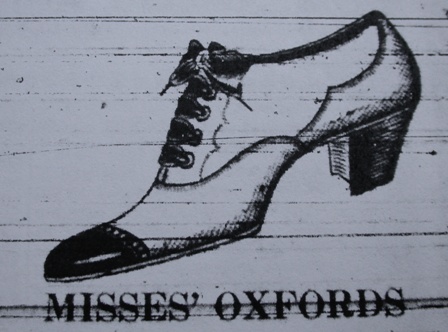
We bought our shoes at Schmidt’s Shoe Store, 124 East Dunklin, in the middle of a block of small stores. Everyone knew Schmidt as Chicken Schmidt. Few people knew his real name, John. Upon entering the store you immediately faced a choice; a partition divided the store into two stores. On the right, Mrs. Edna Schmidt, Chicken’s wife, had a beauty parlor for neighborhood ladies. Boys never went into that side, although we could smell strange odors coming from the hot hair curling machines that women had attached to their heads for “permanents.” It was a bad chemical smell that you couldn’t ever forget, though you might want to.


Schmidt’s Shoe Store, 124 E. Dunklin, ca. 1950.
Photo by Ralph W. Walker, used by permission of Al Case.


On the left, Mr. Schmidt had his shoe store. It was a long, narrow room made narrower by shelves along the walls that went up to the high, tin ceiling. Hundreds of boxes of shoes filled the shelves. To reach the upper shelves, Mr. Schmidt had a ladder on rollers, which slid along a rail near the ceiling. It would have been great fun to stand on the ladder while it rolled along the floor, but I never had the courage to ask Mr. Schmidt for permission to take a ride on his rolling ladder.

In the far back of the store was the shoe repair counter, where I had soles and heels replaced on my leather shoes. Leather shoes were the only kind of shoes we had, even children. Its shelves were lined with pairs of shoes, with tags, waiting to be picked up. The smell of hot leather was powerful. Sometimes when I entered the store, I heard Mr. Schmidt tacking on a new heel on a shoe placed upside down on a last, or the whirring sound of the pulley-mounted leather belt of his polishing machine. He looked up and saw me, and called out to me by my nickname, “Just a minute, Buddy!” He knew everyone in the neighborhood.

Shopping for shoes could be a bore at best, or a tribulation at worst, for a young boy, but Mr. Schmidt didn’t let it be. He joked with me and always had something to give me when we bought shoes. One year he gave to all neighborhood kids a tablet of white, ruled paper for school. It had holes punched in the margin so that it would fit in a notebook binder. The tablet had his name “Schmidt’s Shoe Store” on the blue cover, along with a picture of a grinning Buster Brown with his dog Tige. Mr. Schmidt sold the popular Buster Brown children’s shoes, made by the Brown Shoe Company in St. Louis.

Chicken Schmidt’s name draws laughs from people today. But when you grow up hearing a name from your earliest days, it is just another name. We didn’t ever think it was funny or wonder how he got it, so no one ever knew the origin or ever thought to ask him. Since there were so many Schmidts in the Southside, a nickname helped sort them out. For example, Chicken’s father was known as Hans, not John. Another Southside Schmidt was known as Sprudel Schmidt. Sprudel is German for carbonated water or soda. Yet another Schmidt, who had the saloon in the early Farmers Home Hotel, was known as Eisbär, or polar bear Schmidt. He had an oval wooden sign that hung out over the sidewalk with no words on it, just a painting of a big, white polar bear.


Chicken Schmidt’s Shoe Store, built ca. 1908, was beautifully restored in 2010 by Larry Kolb and Steve Rollins. The original tin ceiling, hardwood flooring, and the floor-to-ceiling oak posts are still there. The building is on the National Register of Historic Places.

Copyright 2011 by Walter A. Schroeder.

------------------------------------

We have a rich history here in Old Munichburg! Join the OMA and help great things to happen here in the twenty-first century!

Tuesday, March 29, 2011

The Southside Drug Store’s One-Arm Wonder

When I was a young boy in the mid 1940s, if I had an extra dime to spend, I went to the Southside Drug Store on Jefferson Street. Mr. Alex (Sandy) Stewart owned the store. Above it, on the second floor, were the offices of Dr. Hoyt Starks, dentist, and Dr. James Stewart, who took care of many in the Southside. At the entrance to the drugstore, the word DRUGS was inlaid in the tile. Even though the drugstore is now gone, that word is still there today when “drugs” has another meaning than medicines.


The Southside Drug Store had a soda fountain with rotating stools on the right side when you went in and newspaper and magazine stands with comic books on the left side. Close to the magazines was a pinball machine that took nickels. I didn’t play it much, but I watched older boys play to see how many free games they could win before they tilted it and lost everything. Toward the back of the store were the other items common to drugstores, like stationery, bathroom things, perfumes, and cosmetics, none of which had any interest to a boy.

Comic books were the main attraction for me, and they cost a dime. However, I really didn’t need a dime, because I could stand and read the comic books there without buying them, if I didn’t stay too long or didn’t get too loud laughing at them. Mr. Stewart had a son my age, Jimmy, so he knew all about boys. Sometimes I bought gum and candy bars, putting my nickel down at the end of the soda counter, where there was always a soda jerk standing to take it.

The Southside Drug Store had another attraction for all the neighborhood kids. Mr. Ferdie Artz, who was missing his left arm, worked in the back, where prescriptions were filled at a counter and where the store’s cash register was. One day years ago, as Southside parents repeatedly told their kids, Mr. Artz had his left arm hanging out a car window. Another car came by in the opposite direction and ripped his arm clean off, which I had absolutely no trouble at all visualizing in gory detail—a detached arm lying in the middle of the street with blood pouring out of it and Mr. Artz’s bloody stub still on his shoulder in the car window. So, when they were riding in cars, all Southside kids were warned by their parents, “Don’t hang your arm out the car window! See what happened to Ferdie Artz!” The lesson was very strong and real. No Southside kid ever hung his arm out a car window.

Mr. Artz didn’t let his misfortune get in the way of his work. He retrieved items from high shelves by knocking them off with his good right hand and catching them between his left stub and chest, placed them on the counter, and wrapped them in paper, leaning over and using the stub end of his left arm to hold the string in place while he deftly flipped the package over and tied a knot with the other, again holding the knot firmly with the stub end. We kids watched and watched and marveled at Mr. Artz, the one-armed wonder of the Southside.

Copyright 2011 by Walter A. Schroeder.

------------------------------------

Do you enjoy these stories about Old Munichburg? “Like” the Old Munichburg Association on Facebook so you can get updates on new blog posts!

Wednesday, February 16, 2011

The Southside Boosters

At the Old Munichburg Association’s January 2011 meeting, Phil Freeman and John Pelzer related how Southside business interests, when organized, can be very effective in accomplishing things.

Here’s some interesting history about the Southside Boosters, an earlier Southside business association, and its accomplishments, taken from Jefferson City newspapers before World War I. (Compiled by Walter A. Schroeder, 2/4/2011.)

---------------------------

The Southside Boosters organized in 1912 to promote the Southside. They met in Friemel’s beer garden atop the hill across from present Central Dairy. According to the newspaper on July 12, 1912, they discussed creating a new bank for the Southside (which was done), securing a policeman for the Southside, and improving the Munichburg fire department next to the brewery on the corner of Dunklin and Washington (not done).

They pushed to have Dunklin become a through street from one end of the city to the other, by cutting down the bluff in the 300 block of W. Dunklin and putting a street down the steep hill past Jackson to connect with Lincoln University and Clark Ave. (done). The city postmaster had already approved a branch post office for the Southside and was waiting for the Boosters to find a location for it (done).

A committee was set up to attend all meetings of the city council “to see that the Southside is taken care of.” Indeed, the newspaper regularly reported on the Southside Boosters actions at city council meetings.

In August 1912, the newspaper reported that farmer Wm. Ahlers was ready to build a $4,000-5,000 building for a creamery in the Southside. Also the Kocher brothers were going to move their cigar factory at 311 Commercial to the Southside, where they lived.


In September 1912, the Southside Boosters contracted with Greater Parker Shows for a weeklong carnival on Dunklin and surrounding streets. Billboards throughout the county advertised it. The carnival attracted large crowds.

It had a brilliantly lighted midway with impressive store fronts for sideshows, all decorated with numerous electric lights; numerous bands, including one big concert band that, after its concert at 7 p.m. broke up into smaller ones; artistic dancers, like “Pharoah’s Daughter”; mysterious illusions like the man who ate rats; a Ferris wheel so high that you looked down upon the buildings of Dunklin Street; Chefalo’s ride through a death-trap loop on a bicycle and leaping 40 feet away, on the corner of Ashley and Jefferson.

The newspaper warned, “Don’t play or shake hands with Madame Electricia or you will get shocked.” And “There is something about a steam calliope that you can’t get away from—maybe it’s the noise!” “One of the female performers is from Columbia and boys from Jefferson City who frequent Columbia recognize her.” Some High Street merchants were chagrined that they were outbid for the carnival by the Southside.


In October 1912, the Boosters wanted a planing mill for the Southside “because there is so much construction going on.” (For those of you too young to remember, a planing mill sawed lumber to specifications.)

In November 1914, plans were announced for a theater at 113 E. Dunklin. It would cost $12,000-15,000 and have a seating capacity of 1,000-1,200, with a floor drop of one inch to one foot that “will allow for good view of the stage everywhere.” This theater building, which was built with a balcony and a decorative terra cotta facade, is still standing. It is the one that Coleman’s Appliance just moved out of.

The city newspaper carried an editorial on Nov. 20, 1914:

The Booming Southside

Ever since the Southside announced that it was going to boom and progress it has done so. Ever since the people organized a boosters club, the Southside organization has devised ways and means of making that section of the city the most important in the city. They want to attract people and so far have succeeded admirably.

The latest addition contemplated in that section of the city is a moving picture show, one of the finest in the west. That will attract people and when one attracts people he attracts business. The Southside is still boosting and if we know the people of that section of the city, they will continue to boost until they have arrived at the goal set for themselves.

In April 1915, the Southside decided it should have a “white way” like the one on High Street. [“White way” referred to the installation of electric lights along the streets and making them “white” at night.] To be along Dunklin from Madison to Broadway; 32 standards with 2 lights each, except at corners, where there would be 4 globes per standard. Next project would be to connect the Southside White Way with the High Street White Way along Madison Street.

The Southside asked that the Jefferson City street car company extend its line into the Southside proceeding up Monroe Street into the new Woodcrest subdivision (where Capital Region Medical Center now is).

And on and on . . .

Copyright 2011 by Walter A. Schroeder.

-------------------------------

Wouldn’t you like to help boost Jefferson City's historic southside neighborhood? Become a member of the Old Munichburg Association today!