Monday, May 23, 2011

Chicken Schmidt’s Shoe Store

In the 1940s, when I was still in elementary school, my family did most of its shopping for clothes and household items on Dunklin Street in the Southside. Since we had no car, it was the nearest and quickest place to go, but more important than that, Mom and Dad knew almost all the store owners and clerks and felt comfortable trading with them. Many of the men and even some of the women who worked in those stores got their hair cut at Dad’s barbershop, and so we returned the patronage. Also, if necessary, we could charge things, with no interest to be paid on the balance. Store owners had a lot of trust in the goodness of the neighborhood people. They knew we would pay when we had the money.

We bought our shoes at Schmidt’s Shoe Store, 124 East Dunklin, in the middle of a block of small stores. Everyone knew Schmidt as Chicken Schmidt. Few people knew his real name, John. Upon entering the store you immediately faced a choice; a partition divided the store into two stores. On the right, Mrs. Edna Schmidt, Chicken’s wife, had a beauty parlor for neighborhood ladies. Boys never went into that side, although we could smell strange odors coming from the hot hair curling machines that women had attached to their heads for “permanents.” It was a bad chemical smell that you couldn’t ever forget, though you might want to.


Schmidt’s Shoe Store, 124 E. Dunklin, ca. 1950.
Photo by Ralph W. Walker, used by permission of Al Case.


On the left, Mr. Schmidt had his shoe store. It was a long, narrow room made narrower by shelves along the walls that went up to the high, tin ceiling. Hundreds of boxes of shoes filled the shelves. To reach the upper shelves, Mr. Schmidt had a ladder on rollers, which slid along a rail near the ceiling. It would have been great fun to stand on the ladder while it rolled along the floor, but I never had the courage to ask Mr. Schmidt for permission to take a ride on his rolling ladder.

In the far back of the store was the shoe repair counter, where I had soles and heels replaced on my leather shoes. Leather shoes were the only kind of shoes we had, even children. Its shelves were lined with pairs of shoes, with tags, waiting to be picked up. The smell of hot leather was powerful. Sometimes when I entered the store, I heard Mr. Schmidt tacking on a new heel on a shoe placed upside down on a last, or the whirring sound of the pulley-mounted leather belt of his polishing machine. He looked up and saw me, and called out to me by my nickname, “Just a minute, Buddy!” He knew everyone in the neighborhood.
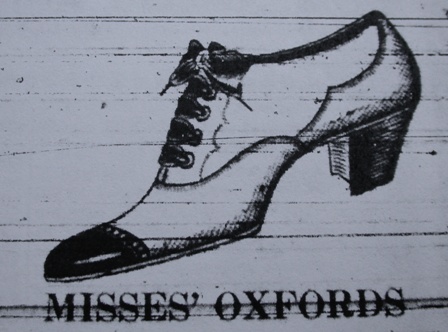
Shopping for shoes could be a bore at best, or a tribulation at worst, for a young boy, but Mr. Schmidt didn’t let it be. He joked with me and always had something to give me when we bought shoes. One year he gave to all neighborhood kids a tablet of white, ruled paper for school. It had holes punched in the margin so that it would fit in a notebook binder. The tablet had his name “Schmidt’s Shoe Store” on the blue cover, along with a picture of a grinning Buster Brown with his dog Tige. Mr. Schmidt sold the popular Buster Brown children’s shoes, made by the Brown Shoe Company in St. Louis.

Chicken Schmidt’s name draws laughs from people today. But when you grow up hearing a name from your earliest days, it is just another name. We didn’t ever think it was funny or wonder how he got it, so no one ever knew the origin or ever thought to ask him. Since there were so many Schmidts in the Southside, a nickname helped sort them out. For example, Chicken’s father was known as Hans, not John. Another Southside Schmidt was known as Sprudel Schmidt. Sprudel is German for carbonated water or soda. Yet another Schmidt, who had the saloon in the early Farmers Home Hotel, was known as Eisbär, or polar bear Schmidt. He had an oval wooden sign that hung out over the sidewalk with no words on it, just a painting of a big, white polar bear.


Chicken Schmidt’s Shoe Store, built ca. 1908, was beautifully restored in 2010 by Larry Kolb and Steve Rollins. The original tin ceiling, hardwood flooring, and the floor-to-ceiling oak posts are still there. The building is on the National Register of Historic Places.

Copyright 2011 by Walter A. Schroeder.

------------------------------------

We have a rich history here in Old Munichburg! Join the OMA and help great things to happen here in the twenty-first century!

Monday, April 25, 2011

The Brewery and Ice House

When I was growing up in the 1940s, the biggest building in Jefferson City’s Southside was the brewery, where the Moerschel family made Capitol Beer. At the time, it was the only brewery in Jefferson City.


It was actually a group of buildings on the east side of Washington, extending from Dunklin back to the alley (now Cedar Way). The alley is about ten feet lower than the bordering streets. The brewery was just around the corner of Washington from our house on Elm Street. On the Washington Street side of the brewery were two deep wells, dug before Jefferson City had a public water supply. Jefferson City beer was made with well water from limestone rocks, not Missouri River water! Mom said that when she was a girl around 1915, when homes had no cold water, she would go to those wells, which always had water flowing out of the top of them, and get a drink of cold well water on hot summer days.

Since, as a kid, I had nothing to do with beer, the brewery itself meant little to me, except for the powerful smell on days when hops and other grains were being cooked. You could smell it all over the Southside. The four-story brew house faced on the alley, which we called “the brewery alley.” The alley was the route I took to get to important places for boys like the Southside Drug Store and Central Dairy. The loading platforms were there too, with trucks coming and going, so I was able to watch a lot of action when I passed by.

Much more important to all of us kids was the brewery’s ice house that sat right on the Dunklin Street brick sidewalk. Also owned by the Moerschels, the ice house provided the whole city with ice. They ice house also had stalls where local grocery wholesalers could keep quantities of meat and fresh produce in storage. People who had ice boxes instead of refrigerators for keeping food cool had square-foot signs that they put in their front windows to signal the deliveryman in the street how much ice to leave on delivery day. The sign had four large numbers—25, 50, 75, 100—along each of the four sides of the square, and the family rotated it so that the number for the size of ice block to be delivered would be at the top of the sign and visible from the street. Some families on Elm Street had ice delivered for their ice boxes, and when the ice truck stopped on our street on hot summer days, it was a signal for all the kids to come out from wherever they were and get pieces of ice from the truck. The young deliveryman sometimes chipped off some ice if there weren’t enough chips already in the truck bed to go around.

Whenever we passed the ice house on hot days we looked for pieces of ice. Mr. Frank Wehmeyer sat out on the loading platform next to the brick sidewalk and joked with all the kids who passed by. Crushed ice was packed in two-layer paper bags, and you could put a quarter in a slot, push a button, and a big bag came rumbling down a hidden chute, then popped out through a window with rubber flaps onto the loading platform. You had your choice when making homemade ice cream: you could get crushed ice in the bag or you could buy a block, take it home, and chip it yourself with an ice pick. Chipped ice, which was thinner, packed better around the ice cream canister than crushed ice, which tended to be chunky. But it was less work to buy the crushed ice. If we got a block of ice, we put it in a burlap sack and two persons carried it home, each holding an end of the burlap sack. Otherwise we used my red wagon. Homemade ice cream was delicious! Folks all over the Southside made homemade ice cream using ice house ice.

The Moerschel Brewery, which began in 1892 (but it continued brewery operations on that site that began before the Civil War), ceased operation in 1947. That was sad for the Southside. The ice house stayed open longer, until 1972, when all the brewery and associated buildings were demolished. The deep wells were capped, and thousands of old bricks (some building walls were seven bricks thick!) and 20,000 cubic yards of dirt were used to bring the site up to Dunklin Street level. A new chain Safeway grocery store was built on the site. It is now a warehouse and parking lot for Prairie Farms (Central Dairy).

Copyright 2011 by Walter A. Schroeder.


--------------------------

Read more about it! Breweries and Saloons in Jefferson City, Missouri, by Walter A. Schroeder, is now available from the Old Munichburg Association for $8 a copy. It’s full of information about Jeff City’s beer history: breweries, tap rooms, beer gardens, and the German immigrant culture that nurtured them.

Tuesday, March 29, 2011

The Southside Drug Store’s One-Arm Wonder

When I was a young boy in the mid 1940s, if I had an extra dime to spend, I went to the Southside Drug Store on Jefferson Street. Mr. Alex (Sandy) Stewart owned the store. Above it, on the second floor, were the offices of Dr. Hoyt Starks, dentist, and Dr. James Stewart, who took care of many in the Southside. At the entrance to the drugstore, the word DRUGS was inlaid in the tile. Even though the drugstore is now gone, that word is still there today when “drugs” has another meaning than medicines.


The Southside Drug Store had a soda fountain with rotating stools on the right side when you went in and newspaper and magazine stands with comic books on the left side. Close to the magazines was a pinball machine that took nickels. I didn’t play it much, but I watched older boys play to see how many free games they could win before they tilted it and lost everything. Toward the back of the store were the other items common to drugstores, like stationery, bathroom things, perfumes, and cosmetics, none of which had any interest to a boy.

Comic books were the main attraction for me, and they cost a dime. However, I really didn’t need a dime, because I could stand and read the comic books there without buying them, if I didn’t stay too long or didn’t get too loud laughing at them. Mr. Stewart had a son my age, Jimmy, so he knew all about boys. Sometimes I bought gum and candy bars, putting my nickel down at the end of the soda counter, where there was always a soda jerk standing to take it.

The Southside Drug Store had another attraction for all the neighborhood kids. Mr. Ferdie Artz, who was missing his left arm, worked in the back, where prescriptions were filled at a counter and where the store’s cash register was. One day years ago, as Southside parents repeatedly told their kids, Mr. Artz had his left arm hanging out a car window. Another car came by in the opposite direction and ripped his arm clean off, which I had absolutely no trouble at all visualizing in gory detail—a detached arm lying in the middle of the street with blood pouring out of it and Mr. Artz’s bloody stub still on his shoulder in the car window. So, when they were riding in cars, all Southside kids were warned by their parents, “Don’t hang your arm out the car window! See what happened to Ferdie Artz!” The lesson was very strong and real. No Southside kid ever hung his arm out a car window.

Mr. Artz didn’t let his misfortune get in the way of his work. He retrieved items from high shelves by knocking them off with his good right hand and catching them between his left stub and chest, placed them on the counter, and wrapped them in paper, leaning over and using the stub end of his left arm to hold the string in place while he deftly flipped the package over and tied a knot with the other, again holding the knot firmly with the stub end. We kids watched and watched and marveled at Mr. Artz, the one-armed wonder of the Southside.

Copyright 2011 by Walter A. Schroeder.

------------------------------------

Do you enjoy these stories about Old Munichburg? “Like” the Old Munichburg Association on Facebook so you can get updates on new blog posts!

Wednesday, February 16, 2011

Mrs. Simonsen Thanked by Students

Simonsen High School was named for Ernst Simonsen in recognition of a gift of $5,000 given in 1914 to the Board of Education by his widow, Fredericka (DeWyl) Simonsen. (He is not to be confused with R. B. D. Simonson, a former superintendent. Incidentally, Mrs. Simonsen was the first woman to become a registered pharmacist in Missouri.)

Mrs. Simonsen also set up other funds for students at the high school (then grades 9–12). On May 12, 1947, Mrs. Simonsen gave an additional $2,000 for a public address system at Simonsen. It was one of the first intercoms in a Missouri school. In the fall of 1947 principal Ruie Doolin let students listen in classrooms to the Cardinals–Red Sox World Series championship games over the intercom, which the Cardinals won. That was before night baseball games.


Ernst and Fredericka Simonsen. These photos appear in Jerena East Giffen, The House on Hobo Hill, p. 117 (see below).


In recognition of Mrs. Simonsen’s gift, school administrators arranged for the entire study body of Simonsen (then grades 7–10) to march later that same May to her house at the northern dead-end of the 600 block of Adams Street to thank her. (Her house is still standing, just across Adams Street from the current Public Schools Administration Building.)

A couple hundred students marched up Jackson, around the corner on Dunklin, and back up Adams to her house and stood in the street while the student body president presented flowers to Mrs. Simonsen. The school band played songs. The short ceremony of gratitude took place on her front porch. On signal, the couple hundred students in the street waved and shouted “Thank you” to the aged benefactress. Mrs. Simonsen died a few months later, in October 1947.

Copyright 2011 by Walter A. Schroeder (class of 1952).

Sources: Author’s personal recollections, and Jerena East Giffen, The House on Hobo Hill: The History of the Jefferson City Public Schools, (Jefferson City, Mo., 1964).

--------------------------------

Support our ongoing efforts to protect and promote Jefferson City’s historic south side neighborhood! Join the Old Munichburg Association!

The Southside Boosters

At the Old Munichburg Association’s January 2011 meeting, Phil Freeman and John Pelzer related how Southside business interests, when organized, can be very effective in accomplishing things.

Here’s some interesting history about the Southside Boosters, an earlier Southside business association, and its accomplishments, taken from Jefferson City newspapers before World War I. (Compiled by Walter A. Schroeder, 2/4/2011.)

---------------------------

The Southside Boosters organized in 1912 to promote the Southside. They met in Friemel’s beer garden atop the hill across from present Central Dairy. According to the newspaper on July 12, 1912, they discussed creating a new bank for the Southside (which was done), securing a policeman for the Southside, and improving the Munichburg fire department next to the brewery on the corner of Dunklin and Washington (not done).

They pushed to have Dunklin become a through street from one end of the city to the other, by cutting down the bluff in the 300 block of W. Dunklin and putting a street down the steep hill past Jackson to connect with Lincoln University and Clark Ave. (done). The city postmaster had already approved a branch post office for the Southside and was waiting for the Boosters to find a location for it (done).

A committee was set up to attend all meetings of the city council “to see that the Southside is taken care of.” Indeed, the newspaper regularly reported on the Southside Boosters actions at city council meetings.

In August 1912, the newspaper reported that farmer Wm. Ahlers was ready to build a $4,000-5,000 building for a creamery in the Southside. Also the Kocher brothers were going to move their cigar factory at 311 Commercial to the Southside, where they lived.


In September 1912, the Southside Boosters contracted with Greater Parker Shows for a weeklong carnival on Dunklin and surrounding streets. Billboards throughout the county advertised it. The carnival attracted large crowds.

It had a brilliantly lighted midway with impressive store fronts for sideshows, all decorated with numerous electric lights; numerous bands, including one big concert band that, after its concert at 7 p.m. broke up into smaller ones; artistic dancers, like “Pharoah’s Daughter”; mysterious illusions like the man who ate rats; a Ferris wheel so high that you looked down upon the buildings of Dunklin Street; Chefalo’s ride through a death-trap loop on a bicycle and leaping 40 feet away, on the corner of Ashley and Jefferson.

The newspaper warned, “Don’t play or shake hands with Madame Electricia or you will get shocked.” And “There is something about a steam calliope that you can’t get away from—maybe it’s the noise!” “One of the female performers is from Columbia and boys from Jefferson City who frequent Columbia recognize her.” Some High Street merchants were chagrined that they were outbid for the carnival by the Southside.


In October 1912, the Boosters wanted a planing mill for the Southside “because there is so much construction going on.” (For those of you too young to remember, a planing mill sawed lumber to specifications.)

In November 1914, plans were announced for a theater at 113 E. Dunklin. It would cost $12,000-15,000 and have a seating capacity of 1,000-1,200, with a floor drop of one inch to one foot that “will allow for good view of the stage everywhere.” This theater building, which was built with a balcony and a decorative terra cotta facade, is still standing. It is the one that Coleman’s Appliance just moved out of.

The city newspaper carried an editorial on Nov. 20, 1914:

The Booming Southside

Ever since the Southside announced that it was going to boom and progress it has done so. Ever since the people organized a boosters club, the Southside organization has devised ways and means of making that section of the city the most important in the city. They want to attract people and so far have succeeded admirably.

The latest addition contemplated in that section of the city is a moving picture show, one of the finest in the west. That will attract people and when one attracts people he attracts business. The Southside is still boosting and if we know the people of that section of the city, they will continue to boost until they have arrived at the goal set for themselves.

In April 1915, the Southside decided it should have a “white way” like the one on High Street. [“White way” referred to the installation of electric lights along the streets and making them “white” at night.] To be along Dunklin from Madison to Broadway; 32 standards with 2 lights each, except at corners, where there would be 4 globes per standard. Next project would be to connect the Southside White Way with the High Street White Way along Madison Street.

The Southside asked that the Jefferson City street car company extend its line into the Southside proceeding up Monroe Street into the new Woodcrest subdivision (where Capital Region Medical Center now is).

And on and on . . .

Copyright 2011 by Walter A. Schroeder.

-------------------------------

Wouldn’t you like to help boost Jefferson City's historic southside neighborhood? Become a member of the Old Munichburg Association today!